What Is Agentic DLP?
Agentic DLP is data loss prevention run by autonomous AI agents that evaluate context and stop unsafe actions before data leaves. Learn how it works and why it's the best approach for protecting your data from exfiltration in the age of AI.

What Is Agentic DLP?
Agentic DLP is data loss prevention run by autonomous AI agents that evaluate context and stop unsafe actions before data leaves. Instead of matching data against pre-written rules, agentic DLP decides whether each action is safe and prevents risky ones in real time.
The word that matters is agentic. An agent here is a piece of software with enough understanding to make a decision without human intervention. It sees a file move, a paste into a chat window, or an upload to a site, and decides where it’s a legitimate action. AI is the architecture underneath that decision, not a sticker on the box. ORION Security built DLP this way because a human review queue can’t keep up with prevention at the speed data travels today.
This is a different job from the one legacy DLP tools were built for. A legacy system asks one question: does this content match a rule? An agentic system asks harder, more useful ones: who is doing this, with what data, in what context, and is this action safe?
The 4 Traditional Types of DLP, and How Agentic Changes the Model
Traditional DLP came in four flavors, split by where it watched: network, endpoint, cloud, and email. Each one inspected traffic in its zone and compared it against policies. Agentic DLP doesn’t add another zone. It changes the engine, replacing the policy match with an agent that reasons about intent across every zone at once.
Network DLP watched data crossing the corporate perimeter. Endpoint DLP sat on laptops and caught local actions like copying to a USB drive. Cloud DLP scanned data sitting in sanctioned SaaS apps. Email DLP inspected outbound messages. Each worked inside its own walls, and each leaned on the same policy match to decide what to allow.
That split made sense when data lived in predictable places. It stopped making sense once an employee could paste a customer contract into a browser-based AI tool that belongs to none of those four zones. Agentic DLP unifies coverage for DLP across surfaces, endpoints, SaaS, cloud, email, storage, web, and the AI tools people now use every day, and applies one reasoning engine to all of them.
A wave of tools added AI to that same policy model and rebranded as next-gen DLP. The model underneath didn’t change; the AI just sorts the alert queue faster. Agentic DLP is the real innovation, because the agent makes the decision in context of the behavior.
Scroll to see the full table (Agentic DLP) →
| Capability | Legacy DLP | Next-Gen DLP | Agentic DLP |
|---|---|---|---|
| Core model | Policy and pattern match | Same policy match, AI added on top | Agents reason about intent and context |
| What AI does | Nothing | Scores and sorts alerts | Makes the decision |
| Coverage | Single zone | Broader, still zone-based | Endpoint, browser, SaaS, email, and supported AI tools |
| Action | Alert for a human to triage | Alert, better sorted | Autonomous action before data leaves |
| Setup effort | Heavy policy authoring | Heavy policy authoring | Minimal, learns normal movement |
| Shadow AI visibility | None | Limited | Built in |
Why Legacy DLP Fails in an Agentic AI World
Legacy DLP fails because the policy model failed, not because protecting data stopped mattering. A rule can only catch what its author thought to describe. People now move data in ways no policy author anticipated, through AI tools that didn't exist when the rules were written, and the gap between what the rules cover and what employees do day to day has become the whole risk.
Most data exposure is accidental. An engineer pastes confidential information into a prompt to get help faster. A salesperson drops a confidential deck into a free AI summarizer. An AI browser, acting for a user, uploads a contract to a third-party site on its own. None of these is malicious. None of these matches a classic exfiltration signature. A rules engine sees nothing wrong.
Shadow AI made the gap permanent. Every security leader knows employees use unsanctioned tools, knows developers paste code into prompts, and knows the company has AI activity it can't see. Few say it aloud, because naming the problem means admitting the current tool doesn't solve it. That silence is the untenable status quo that agentic DLP is built to end.
What Does Agentic DLP Do? 4 Primary Use Cases
Agentic DLP earns its place through four jobs: providing the security team with one view of data movement, flagging shadow AI and SaaS, dramatically reducing false-positive alerts, and supporting a security environment that lets the business move faster. Each job maps to a problem a security leader already has and already struggles to staff against.
Visibility into data movement comes first. One place to see traces across supported channels, click an event, and follow who touched a file, where it came from, what they did with it, and where it went. As one customer put it: "we finally know what is happening with our data."
Safe AI adoption is the second job. A security team can turn on Cursor, ChatGPT, and Claude for engineering, finance, and HR without fear that sensitive data walks out through a prompt. The aim is to make AI usage safe, not to ban it. Blocking the tools just pushes the activity underground.
False-positive alert collapse is the third. Agentic decisions cut the noise that buried legacy teams. For one ORION Security customer, a U.S.-based identity-verification company, AI auto-triage saved an estimated 196 analyst hours in a single quarter. Another ORION Security customer watched its false positives fall from 10,000 a week to under 100. Resource efficiency follows: at one regional insurance brokerage, routine review takes approximately two hours a day from one team member. Security stops being the brake, and becomes the thing that lets people adopt new tools with confidence.
How Agentic DLP Works: Detection, Coverage, Response, and Behavior
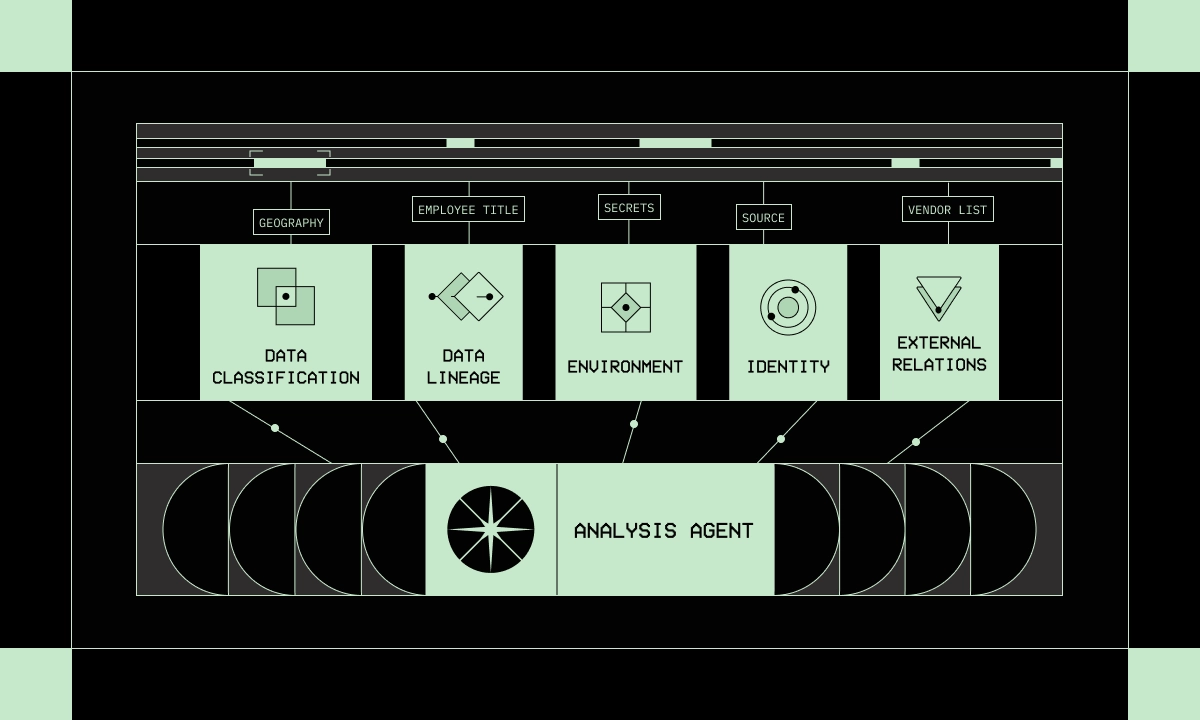
Agentic DLP works across four layers: detection that reads data and context together, coverage across the surfaces it covers, response that acts in real time, and behavior modeling that learns what normal looks like. The agents tie these layers together, so a single decision draws on all four at the moment data moves.
Detection is where AI replaces pattern matching. Instead of asking whether text matches a rule, the system reads what the data is and the situation around it, the user, the destination, the sensitivity, and forms a judgment. That judgment holds up against cases a static rule would miss, like paraphrased confidential information or a screenshot of a contract. As a security engineer at one ORION Security customer described the switch: "it's not regex, it's not patterns, it's a prompt."
Coverage spans endpoints, SaaS, cloud storage, email, web, and supported AI tools through the deployed sensors, extensions, and integrations, so data doesn’t slip between separate tools that each watch one zone. Response is the autonomous part: whether the right action is to allow, warn, or stop depends on intent and context. The agent decides which, then acts before data leaves, where the team has turned enforcement on, rather than filing an alert for someone to read later. Behavior modeling lets the system learn each organization's normal movement, so it flags the genuine outlier instead of drowning analysts. On methodology, what matters is what the agents decide and measure, not the internal mechanics, which stay protected.
If you want to see one view of your data movement across endpoints, SaaS, cloud, and the AI tools your people already use, ORION Security will show you.
Frequently Asked Questions about Agentic DLP
What is the difference between DLP and SIEM?
SIEM collects and correlates security events so teams can see and report what happened across the environment. DLP decides whether a data action is safe and stops the unsafe ones in the moment. Agentic DLP feeds SIEM cleaner signal and acts where SIEM only records. They sit side by side, not in competition.
Is DLP obsolete?
No. The legacy policy model is what failed, not the goal of stopping data loss. With AI pushing more data into more places, preventing loss matters more than ever. Agentic DLP is how the category catches up: the same job, done by agents that read intent instead of rules someone wrote in advance.
What are the 4 types of DLP?
The four traditional types are network, endpoint, cloud, and email DLP, split by where each one watches. Agentic DLP doesn't add a type; it changes the engine, applying one reasoning layer across all of those surfaces and the AI tools that now sit outside them.