DLP for AI Agents: Securing Autonomous Workflows
DLP for AI agents watches the data an agent reads, carries, and sends, and stops sensitive content from leaving before it reaches an external model or service.

Key Takeaways:
- DLP for AI agents technology stops sensitive data from leaving via an AI agent’s actions.
- AI agents have greatly accelerated the risk of data loss because they can move data at machine speed and in high volume.
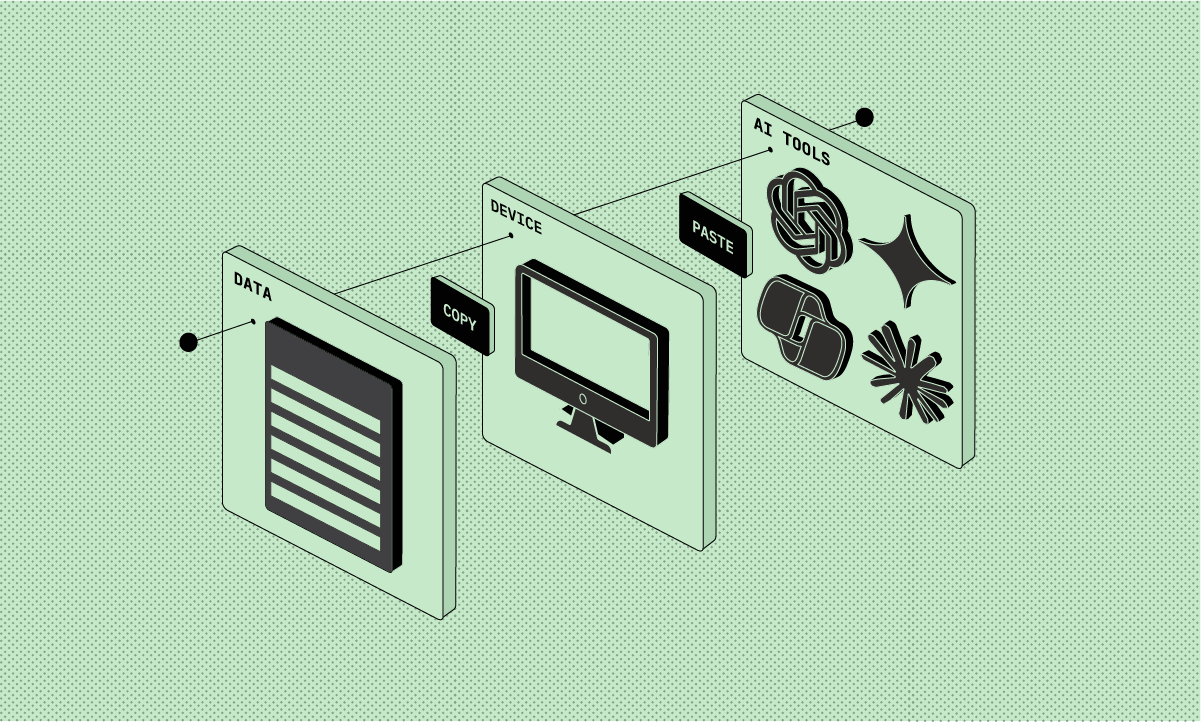
- Security controls built to watch human behavior—cut-and-pastes, emails, uploads—were never designed to manage the speed and actions of AI tools.
- Read all articles in this series, including DLP for ChatGPT, DLP for Claude, DLP for Google Gemini, and DLP for Microsoft 365 Copilot.
Enterprise work is going agentic. Gartner expects 40% of enterprise applications to ship with task-specific AI agents by the end of 2026, up from less than 5% in 2025. There are now agents everywhere in the workplace, writing code, reading vast volumes of documents, and filing work tickets.
The companies that truly leverage this shift will be those that let agents work on their enterprise data safely. This guide covers what data loss protection (DLP) looks like when the “user” is AI software.
What Is DLP for AI Agents?
DLP for AI agents is a set of controls that watches the data an agent reads, carries, and sends, and stop sensitive content from leaving before it reaches an external model or service. Every agent action gets judged the way a human action would: by content, intent, and context.
The definition sounds familiar because the discipline is. What changes is the actor. Classic DLP asked whether a person should be sending this data. Agentic workflows force a sharper question: Should this AI tool, acting on this instruction, be moving this data right now?
Answering it takes a control that sits where the action happens.
Why AI Agents Accelerate Data Loss Risk
Agents accelerate data loss risk in three ways: volume, speed, and the missing human. An employee makes a risky cut-and-paste, and a coach-in-the-moment prompt can reach them. But an agent can make hundreds of data movements in a session, making human review impossible.
And the agents are arriving inside the assistants you already run. ChatGPT now ships agent features that browse and act on a user’s behalf. Microsoft 365 Copilot carries agents built in Copilot Studio. Google has built an agent platform around Gemini. Claude works in the terminal as Claude Code. If you secured these tools as chat windows, their agent forms reopen the question, because a chat window waits for a person and an agent doesn’t.
Consider what a single coding agent does in an afternoon. It reads files across a repository, pulls context from configuration, builds prompts that bundle source code with whatever sits near it, and sends those prompts to a model provider. Each step is legitimate. But any step can carry a credential or customer record along for the ride.
Gartner expects 15% of day-to-day work decisions to be made autonomously by agentic AI by 2028. Every one of those decisions can touch data. The review queue that worked when humans made the moves doesn’t scale to the AI software now making them.
How Enterprise Data Leaks Through AI Agents
There’s a pattern to agent leaks, and most start with permission rather than malice. The agent was allowed in, given access, and pointed at a task. The data loss happens inside the work, where nobody is looking.
The coding agent is the clearest case. Point one at a private repository and it reads what’s there: source, comments, and the API keys someone embedded three years ago. One ORION Security customer, a U.S. mortgage servicer, had engineers using Claude Code with no view of what those sessions were sending. The agent wasn’t misbehaving. The company simply couldn’t see it.
Beyond code, the patterns multiply. A research agent with drive access pulls a board document into a summary it sends externally. An automation an employee wired up on a personal account moves customer records through an ungoverned model. An agent’s accumulated context carries yesterday’s sensitive task into today’s unrelated one. And a manipulated input can steer the agent itself: prompt injection sits at the top of the OWASP Top 10 for LLM applications precisely because an agent that follows instructions can be fed hostile ones, including instructions to send data somewhere it shouldn’t go.
The newest pattern is agents talking to other systems. Modern agents reach databases, ticketing tools, and file stores through connectors and protocol servers, and they hand work to each other in chains. A record that an agent pulled through a connector can travel three hops before anything resembling an egress point sees it. Each hop is an API call, and a security control watching email and uploads doesn’t see any of them.
Why Legacy DLP Can’t See Agents
Legacy DLP watches the places where people move data: email gateways, USB ports, file transfers. An agent works differently, through API calls, tool invocations, and model requests. Traditional controls weren’t designed for these surfaces.
The deeper miss is judgment. A pattern-matching engine asks whether content resembles a card number or a tagged file. The risk of an agent lives in the action: which software is moving the data, on whose instruction, toward which destination, and whether that movement fits the task.
The policy model was built around rulesets based on anticipated human behavior. Software running thousands of novel actions a day breaks that assumption quietly and completely.
Agentic Security for Agentic AI: How Protection Has to Work
Protection for agentic workflows has to work the way agents work: per action, in real time, and judged by AI rather than by a rulebook. Agentic DLP captures what’s about to move, classifies what it contains, reads the context around it, and acts on a verdict before the data leaves.
This is where DLP’s direction of travel meets the agent wave head on. We believe that in five years, DLP that doesn’t act autonomously will be obsolete. Detection is table stakes. The crown jewel is enforcement that happens automatically, without a human triaging an alert queue.
Agents force the issue: when the actor is software making hundreds of moves an hour, the control has to decide at the same speed. A security team can’t review its way through agentic traffic, and with the right architecture it doesn’t have to.
Gartner expects 15% of day-to-day work decisions to be made autonomously by agentic AI by 2028. Every one of those decisions can touch data.
Governing AI Agents in Practice
Start with an inventory, because most companies are running more agents than they think. Coding assistants, browser automations, workflow tools with model connections, employee-built scripts on personal API keys. You can’t put a control in front of a workflow you haven’t found.
Then scope access deliberately. An agent with the whole drive can leak the whole drive, and most agents need a fraction of what they’re granted.
Watch the actions rather than the configuration: visibility into what agents actually send beats any review of what they could send in theory.
And keep the human in the picture. Every agent has an owner, and coaching that person in the moment fixes the workflow instead of just blocking it.
Protection for agentic workflows has to work the way agents work: per action, in real time, judged by AI rather than by a rulebook.
When you evaluate a control for AI tools, ask any vendor three questions:
Does it match patterns written for human behavior, or does it judge each agent action by content and context?
Which agentic surfaces does it see today; are coding assistants included, or is agent coverage a roadmap slide?
How many people does it take to run once agent traffic multiplies? (Because a tool that triples your alert queue has answered the question for you. ORION Security customers run their program with one person, two hours a day.)
The companies getting this right keep their agent adoption moving at full speed, and they say yes to it with confidence, because they can finally see it.
If you want that view of your own workflows, we can show you: ORION Security deploys in 30 minutes and shows real agent activity the same day.
Frequently Asked Questions
Is DLP for AI agents different from DLP for assistants like ChatGPT?
The discipline is the same and the engine should be too. The difference is who initiates the action: an assistant moves data when a person pastes or uploads, an agent moves data on its own, hundreds of times a session. A control that judges each action by content and context covers both.
Can traditional DLP tools monitor AI agents?
Mostly no. Traditional DLP instruments monitor human egress points like email, endpoints, and file transfers, and it matches content against predefined patterns. Agents move data through API calls and model requests at a pace no alert queue can absorb. Watching them takes per-action analysis at the surface where they run.
Are coding agents like Claude Code a data-loss risk?
They can be, because they read everything in scope: source code, configuration, and any secrets embedded in either. ORION Security secures Claude Code in production today, catching code and credentials before they leave while engineers keep their speed.
What about prompt injection?
Prompt injection is the top entry in the OWASP Top 10 for LLM applications, and agents raise the stakes because a manipulated agent can act, including sending data out. Surface-level DLP limits the blast radius: whatever the instruction, sensitive content gets caught at the moment it tries to leave.
Does securing AI agents mean restricting them?
No. The goal is adoption with visibility. Blocking agents pushes teams toward ungoverned personal accounts and homegrown automations you can’t see. The better path keeps agents on sanctioned routes, watches what they actually send, and steps in only when a movement is genuinely unsafe.
Welcome to our DLP for AI blog series. Read the other posts in the series: DLP for ChatGPT, DLP for Claude, DLP for Google Gemini, and DLP for Microsoft 365 Copilot.
ORION Security is agentic DLP, designed to prevent data loss in the AI era. It deploys in 30 minutes and returns a verdict on every data movement in real time: allow, stop, or coach. Request a demo.
.png)